
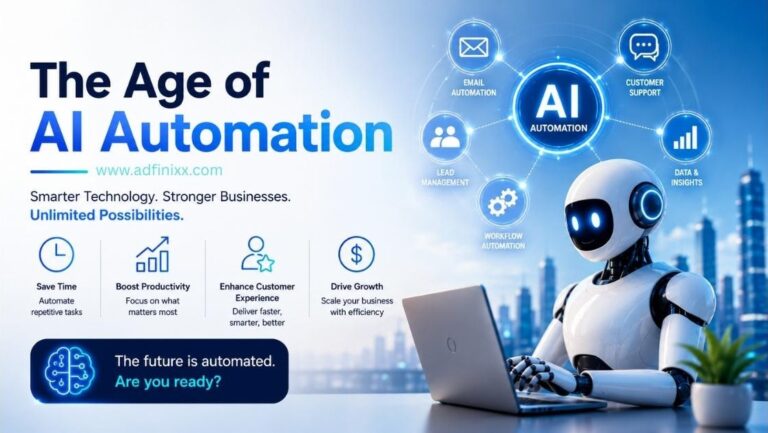
We stand at an inflection point. The machines have learned — and now they're working alongside us, for us, and in some cases, ahead of us. The question is no longer whether AI will transform your industry. It's whether you'll be ready when it does.
Artificial intelligence and automation have long been buzzwords tossed around in boardrooms and tech conferences. But today, something fundamentally different is happening. AI is no longer confined to research labs or bleeding-edge startups — it lives in your inbox, your factory floor, your hospital, your bank, quietly optimizing, predicting, and performing at a scale no human workforce could match.
This is not a story about robots replacing humans. It's a far more nuanced, more interesting story — about how intelligent systems are amplifying human capability, compressing time, and unlocking possibilities that weren't economically feasible even five years ago.
What is AI Automation, Really?
AI automation refers to the use of machine learning, natural language processing (NLP), computer vision, and other AI disciplines to perform tasks that traditionally required human judgment and effort. It goes far beyond simple rule-based scripts or "if-then" workflows that characterised earlier generations of automation software.
Modern AI automation systems observe patterns, learn from data, adapt to changing conditions, and make decisions with a level of sophistication that was science fiction a decade ago. They can read unstructured documents, respond to customers with genuine contextual understanding, detect anomalies in complex systems, and even generate code, designs, and written content — autonomously.
Core AI Technologies Driving Automation
Machine Learning
Systems that improve automatically through experience — finding patterns humans would miss across vast, complex datasets.
NLP & Generative AI
Understanding, writing, and conversing in natural human language — powering chatbots, content generation, and document analysis.
Computer Vision
Machines that see, identify, and interpret visual information from images, video feeds, and the physical world.
Agentic AI
Autonomous agents that plan, reason, and take multi-step actions to complete complex goals with minimal human oversight.
Industry Transformations: Real-World Examples
The sectors being reshaped by AI automation span virtually every corner of the global economy. Each transformation follows a similar arc: early adopters experiment, measure dramatic gains, competitors scramble to catch up, and a new baseline of expectation is permanently set.
Healthcare & Life Sciences
AI diagnostic tools are outperforming radiologists in detecting early-stage cancers from scans, while automated administrative systems cut hospital paperwork by over 50% — returning critical hours to clinicians. Companies like Google DeepMind and Tempus AI lead this charge.
Finance & Banking
Fraud detection algorithms process millions of transactions per second, flagging anomalies in real time. AI-driven risk models replace weeks of manual analysis, and robo-advisors now manage over $1.5 trillion in global assets.
Manufacturing & Supply Chain
Predictive maintenance AI monitors equipment vibration, temperature, and usage patterns to preempt failures — slashing downtime and maintenance costs by 30–40% in leading plants. Siemens and Bosch report significant ROI within the first year of deployment.
Customer Experience
Large language models handle millions of customer interactions daily with context and resolution rates rivalling human agents — at a fraction of the cost and with zero hold times. Brands using AI support report 35% higher CSAT scores.
Marketing & Advertising
AI-powered platforms now automate campaign targeting, creative generation, A/B testing, and budget optimisation simultaneously — compressing what once took weeks of analyst time into minutes of autonomous iteration.
AI automation is not about replacing the workforce. It's about re-equipping it — freeing people from the mechanical to focus on the meaningful.
— World Economic Forum, Future of Jobs Report 2025
The Human Element: Augmentation, Not Replacement
The most persistent fear surrounding AI automation is job displacement. And while certain roles will undoubtedly evolve or disappear, the historical record of technological revolutions tells a more complicated story. The steam engine didn't end labour — it redirected it. The internet didn't eliminate commerce — it exploded it.
What AI automation does most effectively is absorb cognitive drudgery — data entry, pattern matching, routine communication, compliance checking — and return that capacity to humans who can deploy it more creatively and strategically. The companies winning with AI aren't those that eliminated headcount. They're those that combined human intuition and relationship-building with machine speed and precision.
Roles most resilient to automation require genuine creativity, ethical judgment, emotional intelligence, and the management of complex human systems. These aren't niches — they are at the heart of what makes organisations thrive.
Key Takeaways
- AI automation augments human capability — it does not replace human judgment wholesale.
- 73% of global enterprises have already deployed AI in at least one core business function.
- Healthcare, finance, manufacturing, and customer experience are seeing the highest ROI from AI automation.
- The biggest implementation risk is change management, not technology itself.
- Ethical AI design is a competitive advantage, not just a compliance checkbox.
Implementing AI Automation: A Strategic Framework
For leaders navigating this landscape, the imperative is clear — but the path can be treacherous without the right framework. Every successful AI automation initiative shares three common disciplines:
1. Start with the Problem
Define the business bottleneck first, then find the AI solution. Technology-led projects without clear business problems routinely fail within 18 months.
2. Invest in Data Quality
AI is only as intelligent as the data it trains on. Clean, well-labelled, representative data is the non-negotiable foundation of every working automation system.
3. Design for Change
The biggest barrier to AI adoption is rarely technical. Communicating purpose, building trust, and retraining teams is what separates durable success from costly resistance.
The Ethical Imperative
No conversation about AI automation is complete without confronting its responsibilities. Automated systems trained on biased data perpetuate — and often amplify — those biases at scale. Algorithms making decisions about credit, hiring, or healthcare must be subject to rigorous auditing, interpretability requirements, and genuine human oversight.
Responsible AI automation means building systems that are transparent about uncertainty, surface their limitations rather than masking them, and keep humans genuinely in the loop for decisions with significant consequences. The organisations earning lasting trust — and competitive advantage — treat ethics not as a constraint on innovation, but as a core component of it.
What Comes Next for AI Automation
We are still in the early chapters. The convergence of ever-more-capable foundation models, cheaper compute, improving robotic hardware, and maturing agentic frameworks suggests the pace of change will accelerate rather than plateau. Within this decade, AI systems will operate autonomously across complex, multi-step business workflows in ways that seem implausible today.
The opportunity for individuals and organisations is not to predict exactly where this leads — that's impossible — but to build the adaptive capacity to thrive in a landscape of continuous technological change. That means investing in AI literacy, cultivating irreducibly human skills, and approaching automation not as a threat to be managed but as a lever to be pulled deliberately and wisely.
Frequently Asked Questions
Traditional automation follows fixed, pre-programmed rules. AI automation learns from data, adapts to new situations, and handles unstructured inputs — making it suitable for far more complex, variable tasks like document understanding, language interaction, and predictive decision-making.
In healthcare, AI reads medical scans and automates paperwork. In finance, it detects fraud in real time. In manufacturing, it predicts equipment failures. In customer service, it resolves queries autonomously. Each industry sees reduced costs, faster operations, and improved outcomes.
Primarily, AI automation augments rather than replaces. It absorbs repetitive, rule-bound cognitive work — freeing humans for creativity, strategy, and relationship-building. Roles requiring emotional intelligence, ethical judgment, and complex communication remain highly resilient.
Key risks include algorithmic bias (when training data is unrepresentative), lack of transparency in decision-making, data privacy concerns, over-reliance on automated systems without human oversight, and workforce disruption without adequate retraining investment.
SMBs can leverage AI-powered CRM tools, automated email marketing, AI chatbots for customer support, accounting automation, and AI ad platforms. Many of these tools are now available at accessible price points, levelling the competitive playing field significantly.
Ready to automate your business with AI?
Adfinixx helps businesses implement intelligent AI automation strategies — from lead generation to customer experience. Let's build something that scales.
Get a Free Consultation