
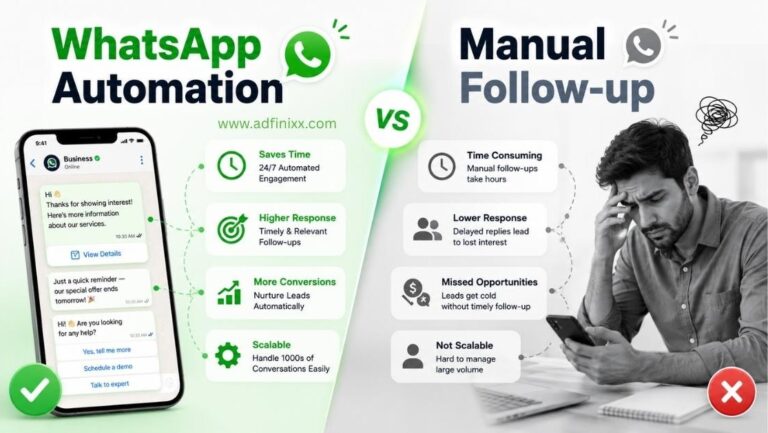
Every business that gets leads on WhatsApp faces the same pressure: respond fast or lose the lead. But should you automate your follow-ups — or keep it personal and manual? The answer in 2026 is more nuanced than you think.
A lead came in at 11:47 PM. One business sent an automated reply in 4 seconds. Another had a sales rep follow up at 10:15 AM the next morning. The first converted. The second didn't. Speed — and strategy — made all the difference.
The Follow-Up Problem Every Business Has
In India, WhatsApp is the default communication channel. Leads come in through ads, website chats, Instagram DMs, and referrals — and they all land in WhatsApp. But most businesses manage this with a single sales rep, a shared inbox, or — worse — a personal number with hundreds of unread messages.
The result is predictable: slow responses, missed leads, inconsistent messaging, and a team that spends more time following up than closing. Manual follow-up at scale doesn't work. But blindly automating everything can feel cold and kill trust. The question is: where's the line?
What is WhatsApp Automation?
WhatsApp automation uses the WhatsApp Business API — not the regular WhatsApp app — to send pre-defined or AI-triggered messages at scale, without a human doing it manually. It covers:
Instant Lead Response
Auto-reply the moment a lead sends their first message — day or night.
Drip Follow-Up Sequences
Send Day 1, Day 3, Day 7 follow-ups automatically without lifting a finger.
Chatbot Qualification
Ask questions, qualify budget and intent, and segment leads before the team steps in.
Appointment Booking
Let leads book a call, demo, or visit right inside WhatsApp — fully automated.
Head-to-Head: Automation vs Manual
Here's how the two approaches compare across every dimension that matters for lead conversion:
| Factor | WhatsApp Automation | Manual Follow-Up | Winner |
|---|---|---|---|
| Response Speed | Under 5 seconds, 24/7 | 5–12 hours on average | 🤖 Automation |
| Consistency | Every lead gets the same quality message every time | Varies by rep, mood, and workload | 🤖 Automation |
| Scale | Handles 1,000+ simultaneous conversations | Limited by team size and hours | 🤖 Automation |
| Cost per Follow-Up | ₹0.50–₹2 per conversation | ₹50–₹200+ per hour of rep time | 🤖 Automation |
| Personalisation | Dynamic but template-based | Fully personalised, adaptive | 👤 Manual |
| Complex Negotiation | Limited — needs human escalation | Full capability | 👤 Manual |
| Relationship Building | Moderate — good for initial trust | Deep, nuanced, high-trust | 👤 Manual |
| Lead Nurturing at Scale | Excellent — sequences run on autopilot | Practically impossible at volume | 🤖 Automation |
| Availability | 24 hours, 7 days a week | Business hours only | 🤖 Automation |
| High-Value Deal Closing | Can support but not replace | Essential for ₹1L+ decisions | 👤 Manual |
The businesses winning on WhatsApp in 2026 aren't choosing between automation and manual — they're using automation to respond instantly and qualify leads, then handing off to humans for the conversations that matter.
— Adfinixx, 2026 Sales Automation Report
When Automation Clearly Wins
Automation isn't the right tool for every conversation — but for these scenarios, it dramatically outperforms manual follow-up:
First Response to a New Lead
A lead who fills a form or clicks an ad needs an instant reply. Automation ensures every lead is acknowledged in seconds, not hours. This single change can increase conversion rates by 30–50% on its own.
Lead Qualification Flows
Instead of a rep asking the same 5 questions 40 times a day, a chatbot does it — collecting budget, timeline, requirements, and contact details before a human ever gets involved.
Follow-Up Sequences for Cold Leads
Leads who go quiet after initial contact rarely get followed up manually. Automation sends Day 3, Day 7, Day 14 messages consistently — recovering 15–25% of cold leads that would otherwise be lost forever.
After-Hours Lead Handling
40% of leads in India come in between 8 PM and 11 PM. Automation ensures these leads are captured, acknowledged, and even pre-qualified before your team starts the next morning.
High Volume, Low Complexity Follow-Ups
Course inquiries, appointment reminders, payment confirmations, service updates — any repetitive follow-up that follows a predictable script is prime automation territory.
When Manual Follow-Up Wins
There are moments in a sales journey where a human touch is not just nice — it's necessary. Automation should step aside and let a person lead when:
High-Value Deals
For purchases above ₹50,000 or complex B2B contracts, a real conversation builds the trust that closes the deal.
Objection Handling
When a lead says "it's too expensive" or "I'm comparing you with X", only a skilled rep can navigate that conversation.
Long-Term Relationships
Repeat clients and high-LTV customers expect personalised attention, not templated messages.
Complaints & Sensitive Issues
A frustrated customer needs empathy, not a bot response. Human handling prevents escalation and preserves the relationship.
The Hybrid Approach That Converts Best
The most successful businesses in 2026 aren't using automation instead of manual follow-up. They're using it before manual follow-up — to handle the volume, filter out tyre-kickers, and make sure every rep conversation starts at the right moment with the right context.
The Hybrid Flow That Works
Step 1 — Automation handles first contact: Lead comes in → instant automated acknowledgement within 5 seconds → qualification questions sent.
Step 2 — Automation qualifies and segments: Bot collects budget, need, and contact info → tags lead as hot, warm, or cold → CRM updated automatically.
Step 3 — Human takes over at the right moment: Hot leads are flagged and assigned to a rep for a personal call or custom message → warm leads go into a nurture sequence → cold leads get a 14-day automated follow-up series.
Result: Your team only talks to pre-qualified, interested leads. Conversion rates go up. Wasted hours go down.
How to Implement in Your Business
Setting up WhatsApp automation doesn't require a big tech team. Here's a practical framework for any Indian SMB or growing business:
Get the WhatsApp Business API
Apply through a Business Solution Provider (BSP) like Wati, Interakt, or Adfinixx — you cannot automate at scale with the regular WhatsApp app.
Map Your Follow-Up Journey
Write out every touchpoint from first inquiry to closed deal. Mark which ones are repetitive — those are automation candidates.
Build Your Message Templates
Create WhatsApp-approved templates for first response, qualification, follow-ups, reminders, and re-engagement. Personalise with name and context.
Integrate with Your CRM
Connect your WhatsApp automation to your CRM so every interaction is logged, leads are tracked, and your team can see full conversation history before picking up the phone.
Key Takeaways
- WhatsApp automation wins on speed, scale, consistency, and cost — it should handle every first response.
- Manual follow-up wins on depth, nuance, and trust — it should close every high-value conversation.
- Businesses that combine both see 30–50% higher conversion rates than those relying on manual follow-up alone.
- The 5-minute rule is real: contacting a lead within 5 minutes makes them 9× more likely to convert.
- WhatsApp has a 98% open rate — it is the highest-converting channel for lead follow-up in India.
- The best approach: automate to qualify, then hand off to humans at the right moment with full context.
Frequently Asked Questions
WhatsApp automation wins on speed, consistency, and scale — ideal for first response and nurturing sequences. Manual follow-up is superior for complex negotiations and relationship-building. The best strategy combines both: automate to qualify and nurture, then let humans close.
WhatsApp Business API pricing in India typically ranges from ₹0.50–₹1.50 per conversation for template messages, depending on your BSP and volume. Platform subscription costs vary — most BSPs charge ₹2,000–₹6,000 per month for small businesses. Most businesses recover this cost within 30–60 days.
WhatsApp automation delivers instant responses — typically under 5 seconds — 24 hours a day, 7 days a week. Manual follow-up in most Indian SMBs averages 5–12 hours, with leads that come in after 6 PM often not receiving a response until the next morning.
Modern AI-powered WhatsApp bots handle FAQs, lead qualification, appointment booking, and payment links well. For complex custom proposals, pricing negotiations, or objection-heavy conversations, a human handoff is recommended — and good automation systems do this seamlessly, passing the full conversation context to your rep.
Yes — from real estate and coaching to clinics, e-commerce, and service businesses. Any business that receives leads on WhatsApp and follows up repetitively can automate those flows. If you send the same message to 10 different leads in a day, that message should be automated.
Ready to automate your WhatsApp follow-ups?
Adfinixx builds custom WhatsApp automation systems for Indian businesses — from first-response bots to complete lead nurturing sequences integrated with your CRM. Book a free strategy call and we'll show you exactly how it works for your business.
Book Free Strategy Call